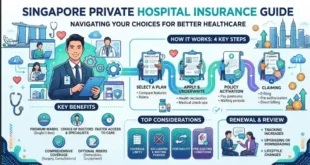
Admission to a private hospital in Singapore usually starts with a doctor’s referral and a pre-admission booking, and you’ll pay a deposit — often around 50% of the estimated bill — before you’re warded. Most insurers need pre-authorization first. This guide covers the paperwork, the deposit, the insurance steps, and the costs you’ll meet along the way.
What private hospital admission really involves
A private hospital admission means you’re warded as a paying patient, not a subsidised one. You choose your own doctor, your own room class, and often your own surgery date. That speed and choice is what you’re paying for.
In Singapore, private hospitals are licensed and regulated by the Ministry of Health (MOH). Public hospitals run a subsidy system based on your income and residency status. Private hospitals don’t. You pay the full bill, then claim back from your insurer or your MediSave account where the rules allow.
The common misconception is that a referral letter guarantees a bed. It doesn’t. The specialist still has to accept you as a patient, and the hospital still has to have a room that matches the class you booked.
Another wrong idea: that your Integrated Shield Plan covers everything. It covers what your policy says it covers, up to its limits. The rest is yours.
Step-by-step admission process
Here’s the order most admissions follow. Times and amounts assume a planned (not emergency) admission at a mid-tier private hospital, so adjust if you’re going somewhere more expensive or booking a suite.
- See a specialist and get a referral. Ask for a written referral with your diagnosis and the procedure name. This usually takes one clinic visit.
- Get pre-authorization from your insurer. Call your insurer or use its app before you book. Ask for the letter in writing. This often takes 3–5 working days.
- Book the admission date with the hospital. Give your name, NRIC or FIN, referral letter, and insurance details. You’ll get an estimated bill.
- Pay the deposit. Most private hospitals ask for a deposit at booking or on arrival — commonly around 50% of the estimated bill, though this varies by hospital and procedure. Confirm the exact figure with the hospital’s admissions counter.
- Complete the pre-admission form and health questionnaire. Declare all medication, allergies, and past surgeries. Hiding something here can void your insurance claim.
- Fast as instructed before surgery. Your surgeon’s team will give you the hours. Follow them exactly.
- Check in on the day. Bring your NRIC or FIN, insurance letter, deposit receipt, and medication list. Arrive at the time given, not earlier.
The one judgement call that separates a smooth admission from a stressful one is getting pre-authorization before you book, not after. If you wait until you’re already warded, you may be treated as self-paying and asked to settle the full bill first.
If your procedure needs a specialist’s licence or a regulated facility — for example, certain surgeries — that’s handled by the hospital and the specialist, not by you. Ask the hospital’s admissions team who is responsible.
Costs and settings at a glance
Figures below are typical ranges for planned private admissions in Singapore. Your actual bill depends on the hospital, the room class, the surgeon’s fees, and how long you stay. Check current rates directly with the hospital, because they change.
| Situation | What to use | How long | What to watch for |
|---|---|---|---|
| Day surgery, minor procedure | Day ward, no overnight stay | Same day | Discharge timing; you’ll need someone to take you home |
| Planned surgery, 1–2 nights | Single room, standard class | 1–2 nights | Room class affects the daily rate, not the surgeon’s fee |
| Longer stay, 4+ nights | Single room or suite | 4 nights or more | Daily room charges add up fast; check your policy’s daily limit |
| Maternity admission | Delivery suite, then ward | 2–4 nights typical | Package pricing vs itemized billing — ask which applies |
| Emergency admission | A&E, then ward | Varies | No pre-authorization possible; insurer must be told within its deadline |
| ICU or high-dependency | ICU bed | Varies | Highest daily cost; check your policy’s ICU sub-limit |
What separates a smooth admission from a messy one
The people who sail through admission do the paperwork before they feel unwell. They get the referral letter, the pre-authorization, and the deposit sorted while they’re still at home, not in a hospital corridor. That’s the whole difference.
They also read the estimated bill line by line. They ask which items are covered by insurance and which aren’t — the surgeon’s fee, the anesthetist’s fee, the room, the medication, and any implants are usually billed separately.
Preparing before the day
- Confirm your room class in writing. A “single room” at one hospital isn’t the same as a “single room” at another.
- Ask for the itemized estimate, not just the total.
- Check your policy’s annual limit and any sub-limits for ICU or specific procedures.
- Bring a list of every medication you take, with doses.
What to check partway through
Once you’re warded, ask the nurse for a running bill if you’re worried. You’re allowed to ask. If a cost looks wrong, raise it with the admissions office before discharge, not after — it’s much harder to fix later.
Leave the medical decisions to the specialist. Don’t self-adjust medication or skip a fast because you feel fine.
Common problems and quick fixes
Most admission problems come down to paperwork, timing, or a mismatch between what you expected and what your policy actually covers. Here’s how to match what you notice to the likely cause.
| What you notice | What it usually means | What to do first |
|---|---|---|
| Insurer won’t confirm cover | Pre-authorization wasn’t done, or the procedure isn’t covered | Call your insurer and ask for the specific reason in writing |
| Deposit higher than expected | Estimate included items your policy excludes | Ask the hospital for the itemized estimate |
| Room class not available | Booked class is full on your date | Ask about the next class up or a different date |
| Bill higher than the estimate | Longer stay, extra tests, or complications | Request an itemized bill and compare it line by line |
| Discharge delayed | Awaiting test results or doctor’s review | Ask the nurse which result is pending |
The rules that apply to private admission
MediSave can be used for hospital bills, but only within MOH’s published withdrawal limits, which depend on the type of stay and the procedure. You can’t simply draw whatever you like. MOH publishes these limits, and your hospital’s admissions team can tell you the current figures.
Integrated Shield Plans are regulated by the Monetary Authority of Singapore (MAS), and the coverage terms sit in your policy document, not in a hospital brochure. Always read the policy, not the marketing.
If your admission involves a work injury, a traffic accident, or a potential negligence claim, that’s a legal matter, not an admissions one. Speak to a lawyer. Don’t sign anything from an insurer or hospital that you don’t understand.
Keeping your records in order afterwards
Once you’re discharged, keep every document in one folder: the discharge summary, the itemized bill, the receipts, and the insurer’s claim reference. You’ll need them if you claim, if you appeal a rejected claim, or if you see another doctor later.
File your insurance claim within your policy’s deadline — check the number in your policy document, because it varies by insurer. Late claims get rejected.
Keep the discharge summary with your regular doctor. It tells them what was done and what medication you’re on. If you feel unwell again, that summary is the first thing a new doctor will ask for.
Photograph each page with your phone as well. Paper gets lost in a move or a flooded basement, and an insurer can ask for a document months after you thought the file was closed.
If your claim is rejected, the appeal usually needs the itemized bill and the discharge summary together, so keep both even after the first claim is paid.
Ask the hospital for the itemized bill, not just the summary one. The summary hides each charge behind a category, and you can’t check a charge you can’t see.
When private admission isn’t the right choice
Private admission isn’t for everyone. If your condition is stable and cost is the main concern, a public hospital with a subsidy may serve you just as well — often with a longer wait.
If your Integrated Shield Plan has low limits, the bill may fall mostly on you. Check the annual claim limit and the deductible before you book. A plan that covers a day surgery may leave most of a private bill to you, since private care is far more expensive than the alternative.
And if you need emergency care, you go to the nearest A&E, public or private, and sort the paperwork after.
For very complex or rare conditions, a public hospital’s specialist team may have more experience. Ask your doctor which setting fits your case.
One common mistake: assuming a private room is faster. For routine surgery, the wait for a private surgeon can be longer than the public queue, and you pay more for it.
Frequently asked questions
How long does private hospital admission take?
For a planned admission, allow 30–60 minutes at check-in, assuming your paperwork and deposit are ready. Emergency admissions take longer because there’s no pre-authorization. Arrive at the time the hospital gives you, not earlier.
How much deposit do private hospitals in Singapore ask for?
Most ask for a deposit at booking or on arrival, commonly around 50% of the estimated bill. The exact figure depends on the hospital and the procedure. Confirm it with the hospital’s admissions counter, because it changes.
Can I admit myself without a referral?
Yes, you can walk into a private hospital’s specialist clinic and ask to see a doctor. But for planned surgery, a referral from your own doctor is usually faster and gives the specialist your history.
Is it safe to use MediSave for a private hospital bill?
Yes, within MOH’s published withdrawal limits. MediSave won’t cover the full private bill in most cases. Check the current limits with MOH or your hospital’s admissions team before you rely on it.
What happens if my insurance claim is rejected?
Ask the insurer for the reason in writing, then appeal with your discharge summary and itemized bill. If the rejection stands, you pay the bill yourself. Read your policy’s appeal process before you need it.
How long do I have to file an insurance claim?
The deadline is set in your policy document, and it varies by insurer. Check your policy or call your insurer. Don’t assume you have months — some deadlines are short.
Can I choose my own room class?
Yes, at a private hospital you choose the class, subject to availability. A higher class costs more per day and may exceed your policy’s daily limit, so check before you book.
Conclusion
Before your stay, call your insurer and the hospital’s admissions desk to confirm what’s covered and what you’ll owe. Ask them to put it in writing, so there are no surprises later. It’s a bit of work upfront, but you’ll walk in calmer and focus on getting better.