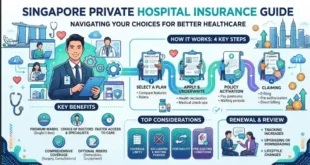
If you’re a foreigner or a Singaporean planning a stay in a Singapore hospital, this Singapore hospital admission guide walks you through the paperwork, the deposits, the insurance steps, and the discharge process. Expect to pay a deposit ranging from about SGD 0 at a public restructured hospital with a letter of guarantee, up to roughly SGD 15,000 or more at a private hospital for a major surgery. The exact figure depends on your ward class, your residency status, and whether your insurer issues a guarantee.
Key Takeaways
- Public restructured hospitals (SingHealth, NUHS, NHG) admit you through a Business Office; private hospitals admit you through their own admissions counter or a specialist’s clinic.
- Your admission letter, NRIC or passport, and insurance policy details are the three documents you can’t show up without.
- Foreigners without a MediSave account pay a higher deposit and a non-resident rate that can be two to three times the subsidized rate.
- A Letter of Guarantee (LOG) from your insurer or employer usually reduces or removes the cash deposit — ask for it before admission day.
- Emergency admissions bypass the deposit queue; you’re stabilized first and billed later.
- Discharge isn’t instant — expect to wait several hours for the final bill, medication, and the discharge summary.
Public vs Private Hospitals
Singapore’s hospital system splits into two very different admission experiences. Public restructured hospitals are government-subsidized and run by three clusters: SingHealth, the National University Health System (NUHS), and the National Healthcare Group (NHG). Private hospitals — including Mount Elizabeth, Gleneagles, Raffles, and Parkway East — are run commercially and price accordingly.
| Feature | Public Restructured | Private |
|---|---|---|
| Admission route | Business Office / A&E | Admissions counter or specialist clinic |
| Ward classes | A, B1, B2, C | Single, double, suite |
| Subsidy | Yes, for citizens/PRs in B2/C | None |
| Typical deposit | SGD 0–3,000 | SGD 3,000–15,000+ |
| MediSave use | Yes | Yes, with limits |
| Waiting time | Longer for elective | Faster for elective |
The key decision is ward class. A B2 or C ward in a public hospital is heavily subsidized for citizens and permanent residents but means an open ward with fans rather than air conditioning. An A ward is a single room with air conditioning and no subsidy. Your ward class determines both your deposit and your final bill more than any other single choice.
Singapore Hospital Admission Process, Step by Step
Step 1: Get Your Admission Letter
Your specialist issues an admission letter stating your diagnosis, the planned procedure, and the expected length of stay. This letter is what the hospital’s Business Office uses to estimate your bill and set your deposit. Without it, you can’t book an elective admission.
Step 2: Pre-Admission Registration
Most public hospitals let you complete pre-admission online or at a counter days before your stay. You submit your NRIC or FIN, your insurance details, and your choice of ward class. Doing this early shortens your wait on admission day considerably.
Step 3: Financial Counseling
For subsidized wards, a medical social worker or business office staff will explain your estimated bill, your MediSave withdrawal limits, and any financial assistance schemes such as MediFund. Take this seriously — it’s where you learn what you’ll actually owe.
Step 4: Admission Day
On the day itself, report to the ward or admissions counter at your appointed time. Bring your original documents. You’ll sign a consent form for treatment and a financial consent acknowledging the estimated charges. If you have a Letter of Guarantee, present it here.
Step 5: The Deposit
You pay the deposit by cash, NETS, or credit card. With a valid LOG, this is often waived. Without one, you pay the full estimated amount.
Pro Tip: Ask your insurer for the LOG at least three working days before admission. LOGs are issued by the insurer’s assistance team, not the hospital, and a last-minute request often doesn’t arrive in time.
What Documents to Bring
Missing a document on admission day can delay your bed by hours. Bring originals, not photocopies.
- NRIC for citizens and permanent residents, or FIN/passport for foreigners and work pass holders.
- Your admission letter from the specialist.
- Insurance policy card and policy number, plus any Letter of Guarantee.
- MediSave is linked automatically to your NRIC, so no card is needed, but confirm your account is active.
- Employer guarantee letter if your company is covering the bill.
- A list of current medications — brand names and dosages.
- Advance Medical Directive or Lasting Power of Attorney documents if you have them.
Costs, Deposits, and Ward Classes
Deposits are estimates, not final bills. The hospital sets them from historical averages for your procedure and ward class. The table below shows typical deposit ranges — your actual figure will differ.
| Ward Class | Who Qualifies | Typical Deposit Range | Subsidy |
|---|---|---|---|
| C | Citizens, low income | SGD 0–500 | Highest |
| B2 | Citizens, PRs | SGD 500–1,500 | High |
| B1 | Citizens, PRs | SGD 1,500–3,000 | Partial |
| A | Anyone | SGD 3,000–8,000 | None |
| Private single | Anyone | SGD 5,000–15,000+ | None |
Foreigners generally can’t access C or B2 wards and pay non-resident rates. If you hold a work pass, check whether your employer’s insurance includes inpatient coverage — many do, but with annual limits that a single surgery can exhaust.
Warning: A deposit isn’t a cap. If your stay runs longer or complications arise, the hospital will ask for a top-up deposit mid-stay. Budget a buffer above the quoted figure.
Using Insurance and MediSave
Singapore runs a layered system. MediShield Life is the national basic health insurance for citizens and PRs, covering subsidized public hospital bills with deductibles and co-insurance. Integrated Shield Plans (IPs) are private add-ons sold by insurers like AIA, Great Eastern, NTUC Income, Prudential, and Singlife, topping up MediShield Life and covering private or A-class care.
MediSave can be used to pay for hospitalization, but withdrawal limits apply per day and per procedure. You can’t use MediSave for a deposit at a private hospital in the same way, and there are annual withdrawal caps.
For foreigners, the picture is simpler and harsher: you pay cash or rely on your own travel or employer insurance. There’s no MediSave for non-residents.
Pro Tip: If you hold an Integrated Shield Plan with a rider, confirm whether the rider still covers the deductible — many riders were changed in recent years and no longer do.
Emergency Admissions
If you arrive through the Accident & Emergency (A&E) department, the process inverts. You’re triaged by acuity, stabilized, and only then admitted. No deposit is collected before treatment. The Business Office catches up with you once you’re in a ward.
A&E charges are separate from ward charges. You’ll see an A&E attendance fee on your bill on top of the inpatient charges. For non-emergencies, going to A&E is expensive and slow — a polyclinic or GP is the correct first stop.
Admission for Foreigners and Expats
Foreigners face three extra steps. First, confirm your pass status — a work pass holder with employer insurance is in a very different position from a tourist. Second, expect a higher deposit, often the full estimated bill. Third, check whether your home-country insurer has a direct billing arrangement with Singapore hospitals; without one, you pay upfront and claim reimbursement later.
Travel insurance rarely covers planned procedures. If you’re traveling to Singapore specifically for treatment, you need a medical tourism policy or self-funding. Confirm the hospital’s international patient services desk can issue the documentation your insurer back home requires.
What Happens at Discharge
Discharge is a process, not an event. Your doctor writes a discharge summary covering your diagnosis, treatment, and follow-up. The pharmacy prepares take-home medication. The Business Office produces the final bill, which may differ from your deposit.
| Discharge Step | Typical Wait |
|---|---|
| Doctor’s discharge order | Morning of discharge |
| Final bill preparation | 1–3 hours |
| Medication dispensing | 30–90 minutes |
| Settlement and refund | 30–60 minutes |
If your final bill is lower than your deposit, the hospital refunds the difference, usually within a few weeks to your original payment method. If higher, you settle the balance before leaving. Ask for an itemized bill — it’s your right, and it’s the document your insurer needs.
Frequently Asked Questions
Can I choose my ward class?
Yes, for elective admissions. You state your preference at pre-admission. For emergency admissions you’re placed by clinical need and availability first, and you can request a change once stabilized. Note that moving from a subsidized to a private ward mid-stay can change your entire bill, so confirm before you agree.
How much deposit do I need for a public hospital?
For citizens and PRs in a B2 or C ward, deposits commonly range from SGD 0 to about SGD 1,500, and are often waived entirely with a Letter of Guarantee. In an A ward, expect SGD 3,000 to SGD 8,000. Foreigners pay substantially more, often the full estimated bill upfront.
Is a deposit refundable?
Yes. If your final bill is less than your deposit, the hospital refunds the difference, typically within two to four weeks. If you cancel an elective admission before the date, deposits are generally refunded in full. Confirm the hospital’s specific cancellation window, as some charge an administrative fee for late cancellations.
Can foreigners use MediSave?
No. MediSave is only for Singapore citizens and permanent residents. Foreigners, including work pass holders, must pay cash or use employer or private insurance. Some employers contribute to a medical benefits scheme, but this isn’t MediSave and has its own limits.
What if I can’t afford the bill?
Ask to speak to a medical social worker before or during your stay. Public hospitals offer MediFund, which is means-tested assistance for citizens and PRs. Private hospitals generally do not. Don’t wait until discharge — assistance is easier to arrange while you’re still an inpatient.
Do I need a referral to be admitted?
For subsidized care at a public hospital, yes — you generally need a polyclinic referral to access subsidized specialist rates. Without one, you’re treated as a private patient within the public system and pay more. For private hospitals, you can usually book directly with a specialist.
One Last Thing Before You Go
Call your hospital’s Business Office and your insurer on the same day, and confirm three numbers in writing: your deposit, your LOG status, and your estimated total. Getting those three aligned before admission day is the single step that prevents almost every billing surprise. Do it a week ahead, not the night before.