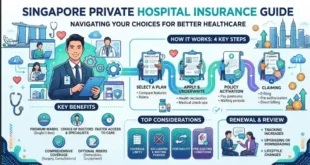
Hospital treatment fees in Singapore depend on whether you’re treated as a subsidised patient at a public hospital or a private one, and on the ward class you choose. A subsidised Singaporean in a C-class ward pays a fraction of a private patient’s bill.
The gap is widest on daily ward charges and doctor fees, which are set per class rather than negotiated. Moving up one class can multiply what you owe, so the class you accept at admission is the single biggest lever on your final bill.
Subsidy follows the patient, not the hospital. A Singaporean who takes a private class loses the subsidy for that stay, while a foreigner pays private rates in every ward.
This guide breaks down the ward classes, the MediSave and MediShield Life rules, and the numbers to expect before you’re admitted.
How Singapore’s hospital system is structured
Singapore runs two tracks: public hospitals and private hospitals. Public hospitals treat both subsidised and private patients in the same building — the difference is the ward class you’re assigned or choose. Subsidised patients get government subsidies; private patients pay full rates.
Ward classes run from C (most subsidised, open ward) up through B2, B1, A, and finally private single rooms. The higher the class, the less subsidy and the more you pay out of pocket. A patient in a C-class ward might pay a few hundred dollars for a procedure that costs several thousand in a private room.
The misconception people bring is that “public hospital” automatically means “cheap.” It doesn’t. If you choose an A-class ward or go as a private patient, you pay close to private hospital rates even inside a restructured public hospital.
The subsidy is means-tested. Your income, and your family’s, decides how much you get.
Step-by-step: what to do before you’re admitted
Here’s the practical order of events. Follow it in sequence, because skipping a step is where people lose money.
- Confirm your residency status first. Citizens and PRs get subsidies; foreigners and most work pass holders don’t. This single fact changes your bill more than anything else.
- Get a referral from a polyclinic if you want the subsidised rate. A polyclinic referral routes you to a public hospital as a subsidised patient. Walking into a hospital’s private clinic (called a Specialist Outpatient Clinic, or SOC) usually means private rates.
- Ask for the ward class options in writing. Before admission, request the estimated bill for each class you qualify for. Hospitals must give you a financial counseling session.
- Check what MediShield Life covers. MediShield Life is the national health insurance scheme. It covers all Singaporeans and PRs for life, but with deductibles and co-insurance you pay first.
- Check your MediSave balance. MediSave is your personal medical savings account. You can use it for yourself and certain family members, within withdrawal limits set by the government.
- Ask about the Integrated Shield Plan top-up. If you have an Integrated Shield Plan from a private insurer, it sits on top of MediShield Life and covers higher ward classes. Confirm what your plan actually pays.
- Ask for the final bill itemized. You’re entitled to see the breakdown — ward charges, doctor fees, medication, tests — before you pay.
The single judgement call that matters most: choose your ward class before admission, not after. Once you’re in an A-class room, switching down mid-stay is difficult and often refused.
If a procedure requires a specialist’s licence or carries real surgical risk, that decision belongs with your doctor and the hospital’s medical team — not with a cost guide.
Key numbers and settings at a glance
Here are the main variations you’ll face.
| Situation | What to use | How long | What to watch for |
|---|---|---|---|
| Citizen, C-class ward | Subsidized rate + MediSave | 1–3 days typical stay | Means-testing on income |
| Citizen, B2/B1 ward | Partial subsidy | 2–4 days | Higher daily ward charge |
| Citizen, A-class ward | Private rate, no subsidy | 2–4 days | Bill jumps sharply |
| PR, any public ward | Reduced subsidy vs citizen | Same as above | Lower subsidy tier |
| Foreigner, public hospital | Full private rate | Varies | No MediSave, no MediShield |
| Integrated Shield Plan holder | Plan pays above MediShield | Per policy terms | Deductible still applies |
| Day surgery | Subsidized day rate | Same day | Cheaper than overnight |
What separates a manageable bill from a painful one
Experienced patients handle the paperwork before they feel unwell. They keep their polyclinic referral current, so a specialist visit stays subsidised. They know their MediSave balance and their Integrated Shield Plan’s deductible, so no surprise lands on the bill.
The order they work in matters too. They confirm ward class at admission, not at discharge. They ask for financial counseling early, when there’s still a choice to make. And they keep every receipt and discharge summary — claims and appeals both need them.
What they check partway through
During a longer stay, they ask the ward nurse for a running estimate of charges. Hospitals can provide this. Catching a cost problem on day two is easier than arguing about it on day ten.
What they leave alone
They don’t upgrade ward class mid-stay for comfort alone, and they don’t assume insurance covers everything. They read the plan’s exclusions once, carefully, before they need it.
Common problems and quick fixes
Most billing problems trace back to one of a few causes. Match what you notice to the likely reason and the first thing to do.
| What you notice | What it usually means | What to do first |
|---|---|---|
| Bill much higher than estimate | Ward class or treatment changed | Ask for itemized bill, compare to estimate |
| MediSave can’t cover the amount | Withdrawal limit reached | Check remaining balance, pay cash portion |
| MediShield Life pays less than expected | Deductible and co-insurance | Read the claim statement, check your plan |
| Foreigner charged full rate | No subsidy for non-residents | Confirm status, ask about payment plans |
| Confusing separate charges | Doctor and hospital bill separately | Request both statements together |
The rules and bodies that apply
MediShield Life is administered by the Central Provident Fund (CPF) Board, and its coverage terms, deductibles, and claim limits are published there — check the CPF Board’s own pages for the current figures rather than relying on any summary. MediSave withdrawal limits for hospital bills are also set by the CPF Board and updated from time to time.
Subsidy levels for public hospital ward classes are set by the Ministry of Health (MOH). MOH publishes the subsidy framework and the means-testing criteria. If you’re unsure which tier you fall into, the hospital’s medical social worker can assess your case — that’s their job, and it’s free to ask.
For foreigners and work pass holders, no subsidy applies and MediSave can’t be used. Payment plans and hospital financial assistance exist, but you must ask.
Keeping your coverage working
Once treatment ends, keep the paperwork. Store your discharge summary, itemized bill, and claim receipts together — you’ll need them if you appeal a claim or file with an insurer later. MediShield Life claims are usually filed by the hospital, but Integrated Shield Plan claims may need your follow-up.
Review your Integrated Shield Plan once a year, or whenever your income or family situation changes. Premiums rise with age, and the plan you bought at 30 may not fit at 50. Check the CPF Board and your insurer’s own published schedule for current premiums.
The sign that it’s time to act: a premium notice you don’t recognize, or a claim you expected to be covered that wasn’t.
When a public hospital isn’t the right choice
Public hospital treatment isn’t always the answer. If you need a procedure fast and the public waiting list is long, a private hospital may be worth the cost — but confirm the full price first.
Ask for the quote in writing, itemized: surgeon, anesthesia, room, implants, and the follow-up visits. The number you’re told on the phone is rarely the number you pay.
If you’re a foreigner with no local coverage, compare private hospital packages against public private-rate bills; sometimes the gap is smaller than expected. Get both quotes for the same procedure code, not a general estimate.
And if your condition needs a specialist your public hospital doesn’t have, a referral elsewhere is the honest move. Ask your doctor directly.
One more case: if you can wait three months without your condition getting worse, the public list usually wins on cost. If waiting risks permanent damage, it doesn’t.
Frequently asked questions
How much does hospital treatment cost in Singapore?
It ranges hugely — from a few hundred dollars for subsidised day surgery to tens of thousands for complex private treatment. The deciding factors are your residency status, ward class, and length of stay. Get a written estimate from the hospital before admission.
Can foreigners use MediSave or MediShield Life?
No. MediSave and MediShield Life are for Singapore citizens and PRs only. Foreigners pay full private rates at public hospitals and need their own travel or international health insurance. Confirm your coverage before you’re admitted.
How long can I stay in a public hospital?
The length depends on your condition and recovery, not a fixed limit. A simple procedure might need 1–3 days; major surgery longer. Your doctor decides discharge timing based on medical need, not cost.
Is it safe to choose the cheapest ward class?
Yes, clinically. C-class wards are open-plan with shared facilities, but the medical care is the same doctors and standards as higher classes. You trade privacy and comfort, not treatment quality.
What happens if I can’t pay the bill?
Ask to speak to the hospital’s medical social worker before discharge. They assess your case for financial assistance and payment plans. Public hospitals have schemes for citizens and PRs who genuinely can’t pay.
How often do I need to review my Integrated Shield Plan?
Review it once a year, and after any major life change — new job, new baby, or a big income shift. Premiums rise with age, and coverage gaps appear over time. Check your insurer’s current schedule.
Why was my MediShield Life claim rejected?
The most common reasons are a deductible you hadn’t met, a treatment outside the covered list, or a claim filed past the deadline. Read the rejection letter, then appeal through the hospital or contact the CPF Board.
Conclusion
The bills are real, but so are the subsidies, the savings accounts, and the people whose job is to help you understand them. Ask early, ask in writing, and keep every document — that’s what turns a frightening number into a manageable one.